diet and health
How to Read Nutrition Facts and Understand What Your Body Needs
How many calories, carbohydrates, protein, and fats does your body actually need? Learn how to interpret Nutrition Facts, understand your individual nutritional needs, and make informed choices about the foods you eat.

How many calories should you eat each day? How much protein is enough? Should you be eating more carbohydrates or fewer? And what about fat and fiber? How do you know if you're getting the right amounts for your body?
These are questions I hear often, and the answers depend on much more than a recommended daily number.
Last year, my partner gave me a professional bioelectrical impedance analysis (BIA) device from RJL Systems, which we've been using at home to track changes in body composition, including muscle mass, body fat, and estimated resting calorie needs. It's been fascinating to see how different we all are, even within the same family.
My twin boys are 18 years old, highly active, and have very low body fat percentages. They can eat thousands of calories a day while maintaining their lean, muscular builds. Their energy needs are considerably different from mine, and what works for them wouldn't necessarily be appropriate for me.
The calories we get from food provide the energy our bodies need for much more than exercise. Every day, we're using that energy to maintain body temperature, support brain function, repair tissues, produce hormones, digest food, and carry out the thousands of cellular processes that keep us alive.
How much energy we need depends on our age, body size, muscle mass, activity level, and overall health. The same is true for protein, carbohydrates, and fats.
This is why there is no single diet or set of nutrient targets that works for everyone.
Nutrition Facts give us valuable information about the foods we're eating. When we understand our individual needs, we can use that information to make more informed choices about how we nourish ourselves.
How Many Calories Do You Actually Need?
Calories are a measure of energy. The food we eat provides the energy our bodies need to function, move, grow, and repair.
The familiar 2,000-calorie recommendation you see on food labels is a general reference used to calculate Daily Values. Your actual calorie needs may be considerably higher or lower.
One of the biggest factors influencing calorie requirements is resting metabolic rate (RMR), which is the energy your body uses at rest to maintain essential functions such as breathing, circulation, and cellular repair.
Muscle mass plays an important role because lean tissue requires energy to maintain. People with larger bodies and greater amounts of lean mass generally have higher resting energy needs.
But resting metabolism is only part of the picture. Your total daily energy expenditure also includes physical activity, digestion, and all the movement you do throughout the day.
One component that often gets overlooked is non-exercise activity thermogenesis (NEAT). This includes everyday movement such as walking around your house, standing, cooking, cleaning, gardening, and moving throughout the workday.
When we consistently consume more calories than our bodies use, the excess energy can be stored, primarily as body fat, leading to weight gain over time. When we consume slightly fewer calories than we expend, our bodies draw on stored energy to make up the difference, which can lead to gradual weight loss. Eating approximately the same amount of energy that we use helps maintain a relatively stable weight.
This balance can shift as our activity levels, muscle mass, and metabolic needs change. Hormones, sleep, stress, medications, and other health factors can also influence appetite, energy expenditure, and how our bodies respond to changes in calorie intake.
Two people who are the same age and weight can have very different calorie requirements depending on their body composition and how much they move.
What Can Body Composition Testing Tell You?
Bioelectrical impedance analysis (BIA) measures how a small electrical current travels through the body to estimate body composition, including muscle mass, body fat, and total body water. Many systems also calculate estimated resting calorie needs.
We use a professional RJL BIA device at home, and I've found it fascinating to track changes in our body composition over time. For the most consistent results, we test first thing in the morning, before breakfast or physical activity, and under the same hydration conditions each time.
BIA can provide valuable insight into body composition when testing conditions are carefully controlled. The measurements are especially useful for following changes over time, while the calculated body composition and calorie values remain estimates.
Protein: How Much Is Enough?
Protein is essential for building and repairing tissues, maintaining muscle mass, producing enzymes and hormones, and supporting immune function.
The adult Recommended Dietary Allowance (RDA) is 0.36 grams of protein per pound of body weight daily (0.8 g/kg). This amount is designed to meet the requirements of nearly all healthy adults and protect against inadequate intake, but it may not be the ideal amount for everyone.
For many adults, a practical starting range is approximately 0.6 to 0.8 grams of protein per pound of body weight daily (1.3 to 1.8 g/kg). Your individual needs depend on your age, muscle mass, activity level, overall calorie intake, and health.
For example, someone who weighs 150 pounds would need approximately 54 grams of protein daily to meet the RDA. Using the higher functional nutrition range, that increases to approximately 90 to 120 grams per day.
People who strength train, are highly active, or are working to preserve muscle as they age may benefit from higher protein intakes. Research also suggests that there is a point where consuming additional protein provides diminishing benefits for muscle growth.
As we age, maintaining muscle becomes increasingly important for strength, mobility, metabolic health, and independence. Adequate protein, combined with resistance exercise, helps preserve muscle tissue.
Rather than consuming most of your protein at dinner, consider including protein-rich foods throughout the day. For many adults, approximately 25 to 40 grams per meal can be a practical starting point, depending on total daily requirements.
Eggs, fish, poultry, meat, yogurt, tofu, tempeh, beans, lentils, nuts, and seeds can all contribute to your daily protein intake.
When reviewing a recipe's Nutrition Facts, consider how its protein content contributes to your overall daily needs. A vegetable soup containing 10 grams of protein might make a wonderful lunch alongside another protein-rich food, while a dinner providing 35 to 55 grams may meet a substantial portion of your daily target.
Carbohydrates: Finding the Right Amount for Your Body
Carbohydrates are an important source of energy, particularly for the brain and working muscles.
When we digest carbohydrate-containing foods, much of the carbohydrate is broken down into glucose. Our bodies use glucose for energy and store some of it as glycogen in the liver and muscles.
During exercise, especially higher-intensity activity, muscle glycogen becomes an important fuel source.
This helps explain why my highly active teenage boys can eat substantial amounts of carbohydrates while maintaining their lean body composition. Their muscles are continually using and replenishing energy through daily activity and exercise.
For someone who is less active or managing insulin resistance, a different carbohydrate intake may be more appropriate.
Insulin resistance occurs when cells become less responsive to insulin, making it harder for the body to regulate blood glucose efficiently. Adjusting carbohydrate portions, choosing fiber-rich foods, and combining carbohydrates with protein and healthy fats can help support blood glucose management. Regular movement and exercise, especially walking after meals and resistance training, can also improve insulin sensitivity by helping muscles take up and use glucose more efficiently.
Some people benefit from a lower-carbohydrate eating pattern, while others do well with moderate or higher carbohydrate intakes.
What Are Net Carbs, and Why Do They Matter?
When you look at Nutrition Facts, you'll see total carbohydrates and dietary fiber. You may also see net carbs, which can be useful when you're paying attention to how much carbohydrate your body digests and absorbs.
Total carbohydrates include starches, sugars, and fiber. Most starches and sugars are broken down and absorbed during digestion, while dietary fiber largely passes through the small intestine without being digested.
Net carbs are generally calculated by subtracting dietary fiber from total carbohydrates.
For example, a meal containing 40 grams of total carbohydrates and 12 grams of fiber would provide approximately 28 grams of net carbs.
40 g total carbohydrates − 12 g fiber = 28 g net carbs
Why does this matter? Two meals may contain the same amount of total carbohydrates but very different amounts of fiber. A meal rich in beans, vegetables, and whole grains may provide more fiber and fewer net carbs than a meal made primarily from refined starches.
Fiber can also slow the digestion and absorption of other carbohydrates, helping moderate the rise in blood glucose after eating.
For people managing insulin resistance, type 2 diabetes, or following a carbohydrate-controlled diet, understanding both total and net carbohydrates can be helpful.
Net carbs are an estimate rather than a direct measure of a food's blood glucose effect. Individual responses also depend on the type of carbohydrate, portion size, meal composition, and metabolic health.
Dietary Fat: Understanding the Different Types
Fat provides energy, supports cell membrane structure, helps produce signaling molecules, and allows us to absorb the fat-soluble vitamins A, D, E, and K.
The type of fat we eat is important because different fatty acids have different roles in the body.
Monounsaturated fats, found in olive oil, avocados, and many nuts, can support cardiovascular health when they replace some saturated fats in the diet.
Polyunsaturated fats include the essential omega-3 and omega-6 fatty acids. These fats are involved in cell membrane function, growth, and the production of compounds that regulate inflammation and other physiological processes.
Omega-3 fats include alpha-linolenic acid (ALA), found in flaxseeds, chia seeds, and walnuts, along with EPA and DHA, found primarily in fatty fish and certain algae.
Saturated fats are found in foods such as butter, coconut oil, fatty meats, and dairy products.
There is no single ideal fat intake for everyone. Overall energy needs, metabolic health, food preferences, and dietary patterns all influence how much fat may be appropriate.
Fiber: One of the Most Important Nutrients to Track
Fiber deserves special attention because it influences several aspects of health. Dietary fiber helps support regular bowel movements, feeds beneficial gut microorganisms, and can improve blood glucose and cholesterol regulation.
Certain fibers are fermented by intestinal bacteria, producing short-chain fatty acids such as butyrate. Butyrate provides energy for cells lining the colon and helps support intestinal barrier function.
General adult fiber recommendations range from approximately 25 to 38 grams daily, depending on age and individual energy needs. Beans, lentils, vegetables, berries, whole grains, nuts, and seeds are excellent sources.
When reviewing a recipe's Nutrition Facts, look at how much fiber it provides per serving. A meal with 8 to 12 grams of fiber can make a substantial contribution toward your daily needs.
Some people may benefit from consuming 40 to 50 grams of fiber daily, particularly when eating a diverse range of whole plant foods. However, someone currently consuming 10 to 15 grams daily may experience digestive discomfort if they increase their intake too quickly. Gradually increasing fiber while drinking adequate fluids allows your digestive system and gut microbiome time to adapt.
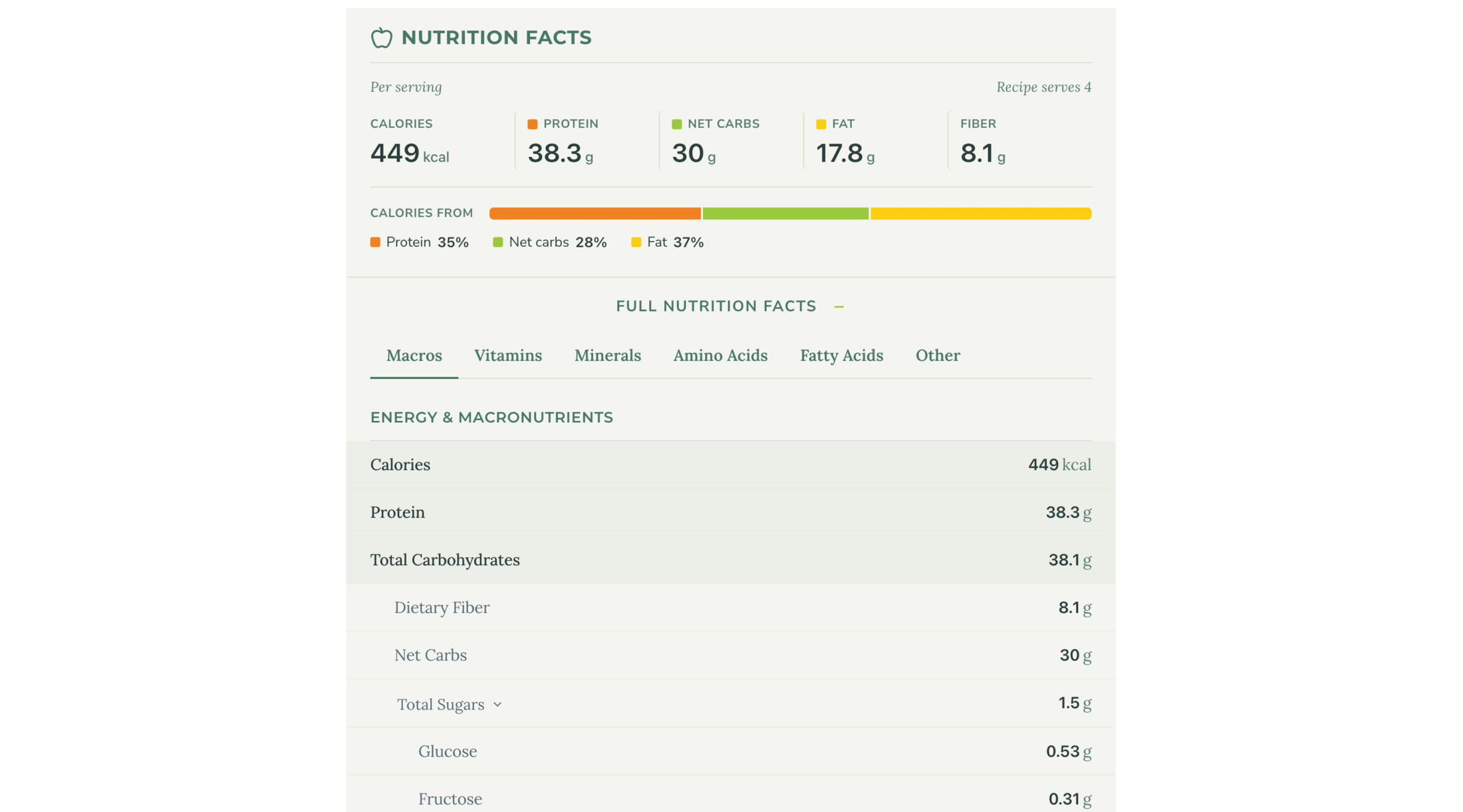
What Should the Nutrition Facts for a Meal Look Like?
Now that we've looked at calories, protein, carbohydrates, fat, and fiber, how do you know what a balanced meal should provide?
This depends on your age, activity level, body composition, and how much you're eating throughout the rest of the day.
My 18-year-old twin boys regularly eat meals containing 800 to 1,200 calories, made entirely from nutrient-dense whole foods. Both are highly active, with substantial muscle mass and estimated body fat percentages ranging from 10 to 15%. They need plenty of energy to fuel their activities, maintain muscle, and support recovery. They call their approach "clean building" because they focus on getting their calories from whole foods rather than processed foods and added sugars.
For someone with lower energy needs, a meal containing 450 to 700 calories may be a better fit. How much we need at each meal depends on our age, body size, muscle mass, metabolic rate, activity level, and how much we're eating throughout the rest of the day.
For many adults, a main meal containing approximately 25 to 40 grams of protein, a generous serving of vegetables, fiber-rich carbohydrates, and healthy fats can provide a good balance of nutrients.
For someone with high energy requirements, a meal might contain 50 to 80 grams of protein, larger portions of whole-food carbohydrates, and additional healthy fats.
Fiber is another helpful number to consider. A meal providing 8 to 12 grams of fiber can make a substantial contribution toward your daily needs, especially when you're eating plenty of vegetables, beans, lentils, and whole grains.
Someone who eats a large breakfast and lunch may prefer a lighter dinner. Someone who eats smaller meals earlier in the day may need a more substantial evening meal. And on days when you're particularly active, your energy and carbohydrate needs may increase.
The Nutrition Facts for one meal are most useful when considered alongside your overall daily intake and how you feel.
Looking Beyond Macronutrients
While calories, protein, carbohydrates, fats, and fiber are important, vitamins and minerals are also essential for energy production, immune function, nervous system health, and cellular repair.
Nutrients such as iron, folate, potassium, magnesium, vitamin E, selenium, and vitamin B12 all have different roles in the body, and our needs can vary with age, life stage, diet, and health conditions.
In an upcoming article, we'll take a closer look at these nutrients, how much you may need, and the whole foods that provide them.
Learning to Listen to Your Body
Nutrition Facts provide useful information, but your own experience matters, too.
Notice how you feel after meals. Do you have steady energy? Are you comfortably full? Do you feel nourished and ready to move through your day?
Pay attention to your appetite, digestion, sleep, exercise recovery, and how your needs change with activity and life circumstances. These observations can help you recognize patterns, especially when combined with information about your food intake.
Sometimes you may need more food, more protein, or additional carbohydrates to support activity. Other times, adjusting meal composition or portion sizes may help you feel better.
Understanding your nutritional needs is an ongoing process. The more you learn about your body and the foods you eat, the easier it becomes to make choices that support your health.
Explore the Nutrition Facts for Your Meals
After years of research and development, we've created our own detailed Nutrition Facts system for Nourishing Meals®. Every recipe now includes calories, protein, total and net carbohydrates, fats, fiber, vitamins, minerals, amino acids, fatty acids, and selected plant compounds.
Members can also add their own recipes, modify existing recipes, and create quick meals with automatically calculated Nutrition Facts.
Explore the nutritional value of your favorite meals and discover how they can support your individual needs.
 More about Alissa



Add a Comment